
The national final season for Eurovision 2025 is in full swing. Fans are revelling over the slew of new songs we’re getting and, of course, discussion are rife about who will win. The show is just under three months away, and it’s clear that everyone is thrilled to have the Contest back once again.
But in recent weeks, there has been a steady rise in discourse surrounding two of this year’s entries. Malta’s “Kant” and Finland’s “Ich Komme” have caused a stir in both Eurovision and non-Eurovision circles. On top of this, the treatment of women in selections such as Sanremo have cast a dark shadow on Eurovision’s already-dimmed shine this year.
I believe that some of the (quite frankly, vitriolic) responses to these songs are because we expect women to act in a certain way in the arts. Eurovision fans are amazing supporters, but the hunger for more can end up swallowing artists whole. Many will disagree, arguing that men are just as under the spotlight as their female counterparts. But despite everything, these conversations on expectations for women are happening in the Eurovision sphere – whether we like it or not. So, let’s break it down.
Disclaimer
Just before we get started, I understand the irony of a cisgender man writing about the impact of the patriarchy on women and non-binary performers. It is something that I do feel odd doing, as I am allowed the space to discuss these topics, potentially taking space away from other voices, specifically those who are performers themselves. Female artists and artists who identify as non-binary hold such an enormous space in the world of music, but are often unable to voice their true thoughts. I hope that this editorial will help to highlight their plight – at least within a Eurovision context.
Understanding the patriarchy
So, let’s kick off with what the patriarchy actually is. In this world of culture wars and misinformation, many hear the term thrown around without understanding what it means. So, to simplify things:
Patriarchies are systems of society where men are traditionally more favoured than women. This can be in the form of a family where the eldest male is seen as the head of the family. However, it can also be in the political sphere, where men are the ones who benefit, with women sat on the side lines, getting no word in edgeways. Traditionally, more marginalised communities have struggled to fight for their rights in patriarchies; including women, the LGBTQ+ community, people with disabilities, people of colour, ethnic groups etc. Only in the 20th century were women allowed to vote in the vast majority of countries. This is the result of the patriarchal system, where men felt threatened at the possibility of women being included in the conversation and shifting priorities.
As the decades went on, social changes allowed for a vast swathe of people from diverse backgrounds a chance in life. This is still an ongoing process, however, as the political winds change regularly which can help or hinder different causes. However, while the patriarchy slowly becomes more tolerant, the mentality of the patriarchy also spreads to those who are now involved in the conversation. An example of this could be a gay man who argues that civil partnerships are enough rights for LGBTQ+ people to have and that marriage should not be afforded to them. Similarly, a person of colour from an immigrant background who says that refugees should not be able to enter the country is another case. These mentalities are dangerous and lead many to forget the path many struggled for so they could live the life they have now.
….So what does this have to do with Eurovision 2025
Within a Eurovision 2025 context, it’s fair to say that there is a wide array of opinions that stretch generations, cultures and backgrounds. But in the past number of weeks, discussions around female agency have come to the fore. As well as this, dictations on what women can and cannot do are causing major discourse among fans, with some resorting to humiliating and dehumanising terms just to get their point across.
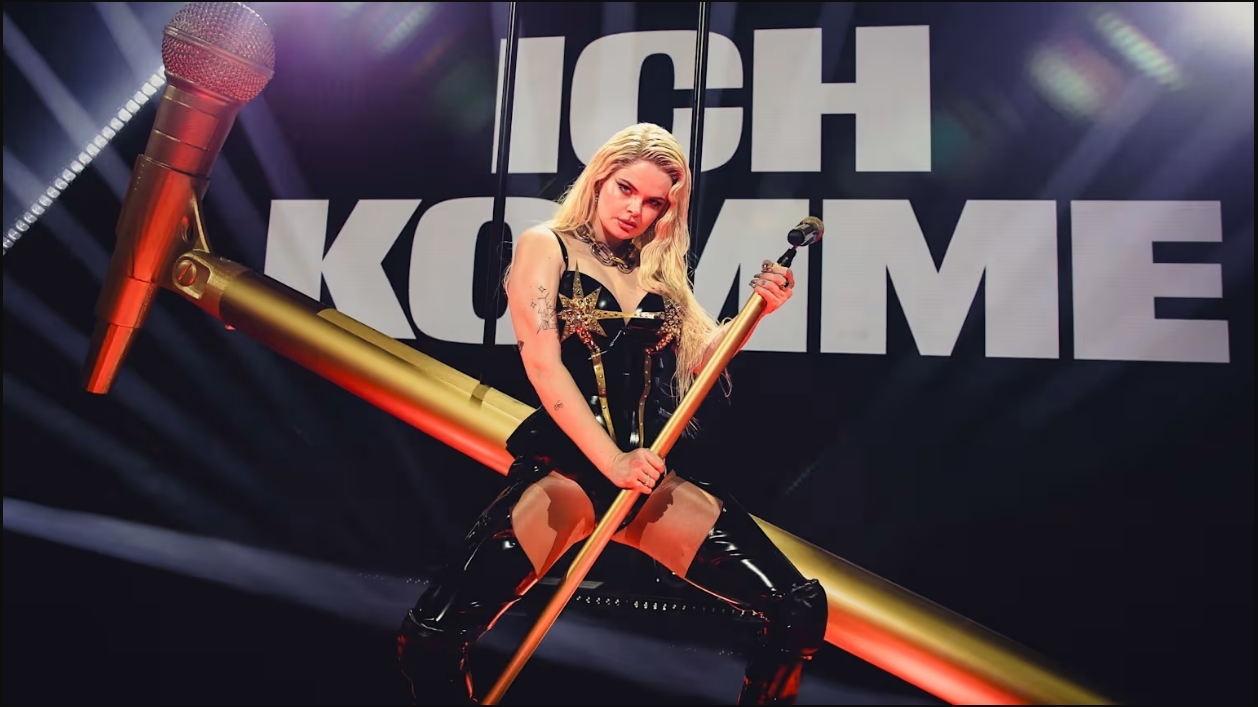
Let’s start with the obvious. Erika Vikman offering us one of the most challenging songs of the year so far. Following the release of “Ich Komme”, fans were left stunned at the racy nature of Erika’s track. She also did not beat around the bush when it came to the meaning of the song. One simple look at the lyrics tells you the song is about pleasure. Specifically, sex – and her ability to command pleasure in the heat of the moment. This is complete sex, from the music video to the outfit she wears on stage.
However, within minutes of her victory in UMK – some fans were up in arms about her victory. Surprisingly, a high number of these detractors were fellow women, or people who were older. The hatred has since continued even to this day. While researching for comments, I found one male fan said:
It’s an abomination. Folk may not have wanted to see Olly [Alexander, UK 2024] writhing around in a men’s room, but I’d rather see that than some s**t trying to ram a giant microphone up her jacksy.
A second post, written by a woman fumed:
Do you girls really think this is a flex? She looks s**tty and panders to every neanderthal heterosexual stereotype of a subversive woman type in existence. And don’t use the “she can wear what she likes” line with me. Yes, she can, but really needs to think about the messages those choices convey, and as part of what is still regarded as family viewing.
Similarly, another post written by a man added that her performance was geared towards straight men:
Finland, well what a song and performer. […] What a talking point to straddle a steel girder as fireworks fire out your ass. […] The straight men will lap it up.
Other comments branded her performance as “shameful”, “cheap”, “vile” and “pornographic”. However, Erika has fought back against these comments by keeping quiet. She has not needed to defend herself because she won with an astonishing televote margin. Her previous entry, “Cicciolina”, is also full of innuendo and sex, and yet that song is celebrated universally in the community. So, what’s changed?
Serving… moral panic
To answer this question, we need to take a look at another “offender” from this year’s Contest. Miriana Conte from Malta has similarly sent fans into panic with her track “Kant”. While being a run-of-the-mill pop song, the use of the word “kant” – a Maltese word meaning “singing” – has caused pandemonium among fans and broadcasters alike.
The discourse here comes from the similarity to the word “cunt” – a heavy swear word in the English language. Originally a slang word for a vagina, the word has historically been used as a slur and a swear word. But in the last decade or so, the word has obtained a new meaning as part of the phrase “serving cunt”, which means to do something flawlessly and with sass, specifically by the LGBTQ+ community.
The EBU has already cleared “Kant” for Eurovision 2025 – so the song will remain as is in Basel. However, this has not stopped fans from criticising the song for its lewd allusions. One fan, in response to our article confirming Miriana’s selection said:
I think it will cause major issues. Personally, I think it’s a bit crass.
Reaction to the song has gotten so dramatic, that British tabloid newspapers are saying the song will have to be censored by the BBC. This will not happen, due to the aforementioned clearing by the EBU. But again, public backlash to this song has been uncharacteristic. Why?
Hard work – for nothing
Let me chuck in two other major cases for this that came to the fore in the past week. In Italy, Olly emerged victorious in Sanremo – despite being a surprise outsider. However, what triggered many fans was that the top five acts featured no women whatsoever. This came despite Giorgia, having led for much of the festival, to crash out in 6th place.
Sanremo’s treatment of women has always been a talking point – and a source of humour – for many fans. However, this year’s lack of female representation rubbed many – including female acts themselves – the wrong way. During a press conference after the show, Elodie went viral for hitting out at the results. In the clips that spread across social media, Elodie said:
It always seems that women have to do somersaults, sing well, be great performers, even do pole dancing. It’s never enough. It’s not a question of victimisation, it’s objective data, it’s statistics.
We are always in the minority and it makes us angry: we are not artistically inferior.
In a similar vein, Poland’s Eurovision 2025 representative Justyna Steczkowska had said there had been minute problems with her performance due to the fatigue and stress caused by her preparations for the national final. While she insisted this was part of her vision for her show, it also raises questions as to how much do female artists have to push themselves to be taken seriously.
Hypocrisy in action
With all these points made, it begs the question – why are we making women jump through hoops? Do we push men through the same lens and scrutinise every detail? Hardly ever. One case in point is Finland’s previous two entries – “Cha Cha Cha” and “No Rules!”. For his performance in Liverpool, Käärijä was shirtless, save for the oversized bolero he wore on his arms. Windows95man ran around the stage in Malmö with his bum fully visible for part of the performance. Benjamin Peltonen – who also competed at UMK in 2023 – literally had a song which explicitly pleaded for a man to have sexual intercourse with him. However, the response from fans was far more positive or neutral than what the women at Eurovision 2025 are facing.
The Eurovision fandom itself is a form of patriarchy, it must be said. The vast majority of fans are men – many of whom are part of the LGBTQ+ community. While this is an improvement on typical patriarchies, where heteronormative ideas are pushed, it’s a patriarchy nonetheless. As fans, we celebrate women for their music – more women have won Eurovision than men. However, that does not mean we put immense pressure on female performers. We judge them on their outfits far more than we do with men. We expect bigger and better things every single year, to the detriment of artists’ health and safety.
But this year, Eurovision 2025 is – so far – standing up against patriarchal ideals. Women are singing about the euphoria of orgasms – and they are doing it for THEMSELVES, and not the benefit of men. They’re feeling proud of themselves and pushing boundaries in ways so many men just couldn’t. As fans, we should recognise that and applaud it, not fuel the flames higher with vitriolic and misogynistic discourse.
What next?
At the time of writing, we already have over half of the songs for Eurovision 2025 confirmed. There are still more artists set to release their songs for Basel, all of which will inevitably be scrutinised. Come rehearsals, it will become a bloodbath of opinions once again. However, we should remember – just because you don’t like something doesn’t mean you should resort to debasing insults. Women should be allowed to sing about what they want, just as much as men. Fans – and casual viewers alike – need to check their unconscious bias and ask these vital questions. It makes everyone’s enjoyment of the Contest better – and who doesn’t want that?
Ultimately, many of the criticisms made here are a direct result of the rising far-right and misinformation. Social media have elevated these to new and scary heights, and I don’t see it getting better anytime soon. But overall, Eurovision 2025 is proving once again that it is raising questions of how we should be viewing these songs. Do we look at these through the lens of a world where panic is triggered if a woman can enjoy sexual pleasure? Or should we see this as an awakening of female empowerment, using Eurovision 2025 as a soapbox? I leave that as an exercise for you, dear reader.
Do you agree with what I have to say in my editorial? As always, please let us know what you think by getting involved in the comments below. Also, be sure to follow ‘That Eurovision Site’ on Facebook, Instagram, Twitter, TikTok, Threads, tumblr, and Bluesky for more information about Eurovision 2025!
News Source: That Eurovision Site / Aussievision / Dziennik Eurowizyjny / The Mirror / Lovin’ Malta
Photo Credit: Yle
 Euan T