
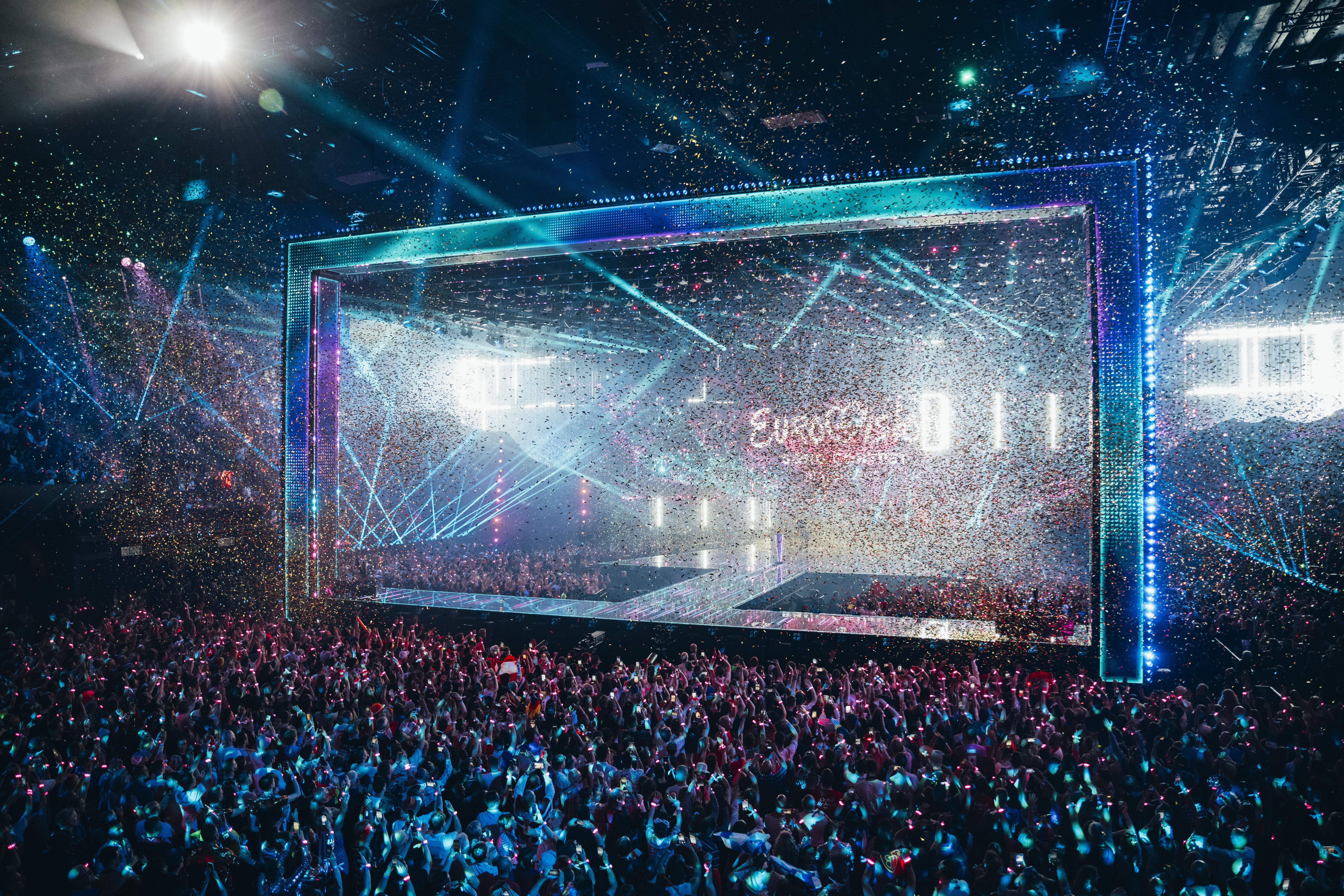
Anti-booing technology will not be brought in to use during next year’s Eurovision Song Contest. The move was confirmed by Executive Producer Michael Krön.
Large-scale protests won’t be covered
Reporting the progress of preparations, Austrian broadcaster ORF spoke with Krön, as well as ORF’s Program Director Stefanie Groiss-Horowitz about the potential for protests surrounding Israel’s participation in Vienna. Following the boycott of five countries due to Israel’s participation being greenlit, it is expected that demonstrations will be held surrounding their ability to participate.
Stefanie said that ORF will attempt to avoid covering large-scale protests. She explained:
If there are large protests, then we won’t cover them. But if there are smaller groups, then we don’t have to cut to every single protester.
Anti-booing technology will also not be used for this edition. This was confirmed by Krön, who added:
If it were up to me, we wouldn’t sugarcoat anything, because our job is to show what is.
Anti-booing technology piloted in Vienna
Vienna, controversially, introduced anti-booing technology the last time it hosted Eurovision back in 2015. At the time, the move was done to silence large booing in the arena to Polina Gagarina who was representing Russia. The move came one year after Russia annexed Crimea and set up separatist states in the east of the country.
In a statement to the Syndey Morning Herald after the Contest at the time, former communications coordinator Jarmo Siim said of the booing towards Polina:
It was very embarrassing for us last year when this happened, as it is not in the spirit of the contest.
It is the first time we have prepared in this way, we want to be ready in all scenarios [but] we have high expectations that nothing like this will happen.
Since then, anti-booing technology was retired, but brought back in 2024 and 2025 in response to heightened tensions surrounding Israel and their participants. The EBU denied using anti-booing technology in 2024, saying they “do not censor sound from the arena audience”.
The story of Eurovision 2026 so far
The journey to the 2026 Eurovision Song Contest kicked off immediately following JJ’s win in Basel, when Austria’s ORF accepted the rights to host the 70th edition of the contest. The bidding process started in June, with interested cities having until July 4 to submit their bid book. Innsbruck and Vienna were shortlisted, with the latter winning the right to host next year’s contest. 35 countries will take part in the competition, the lowest number of competing entries since 2004.
As for the organisation of the competition, the ‘core team‘ was revealed in June 2025, with further details about next year’s competition to be revealed in due course. The shows will take place on May 12th, 14th and 16th.
What do you make of the move to remove anti-booing technology? Do you think it will make a difference? As always, please let us know what you think by getting involved in the comments below. Also, be sure to follow ‘That Eurovision Site’ on Facebook, Instagram, Twitter, TikTok, Threads, tumblr, and Bluesky for more information about Eurovision 2026!
News Source: ORF
Photo Credit: Sarah Louise Bennett / EBU