
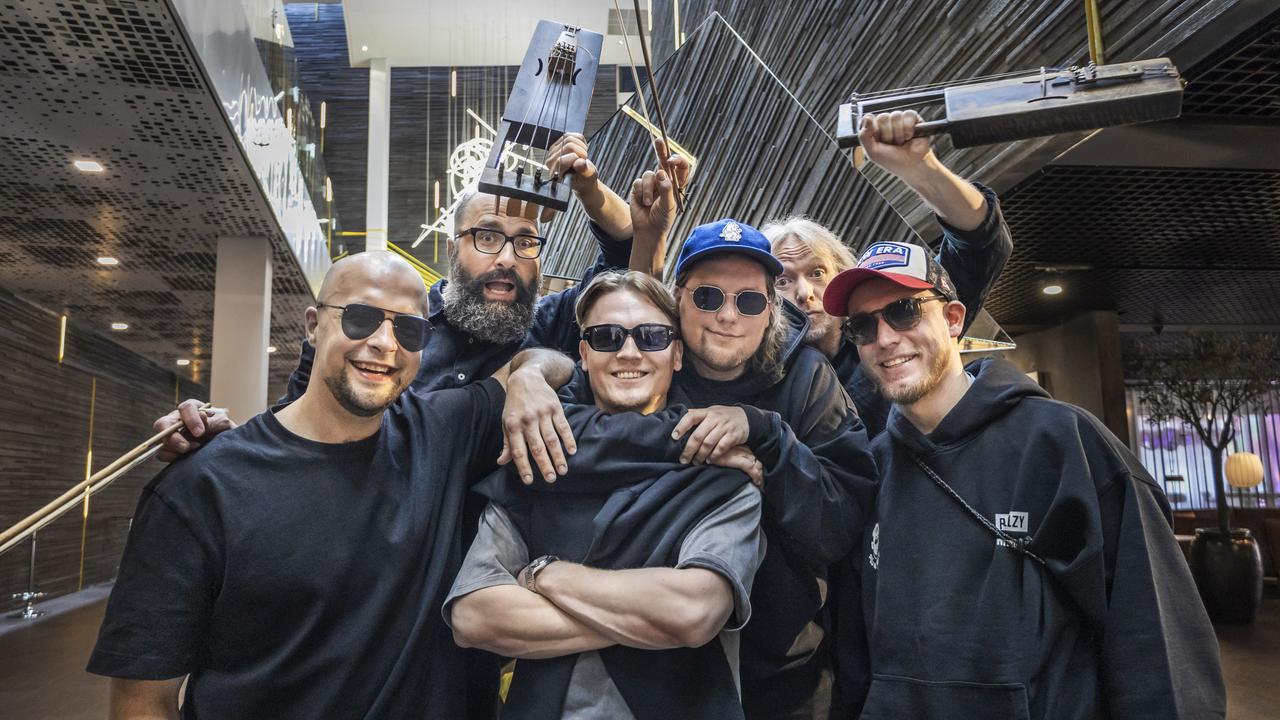
To date, there have been 1,758 entries in Eurovision Song Contest history. As Eurofans, we may only know these artists from one or two songs, but every artist that has performed at the contest has an extensive backlog. This series, Beyond Eurovision, aims to shine a light on some of the That Eurovision Site team’s favourite Eurovision artists’ discographies. Today, we look at 5MIINUST and Puuluup, who represented Estonia at Eurovision 2024, and their collaborative album, “Kannatused ehk külakiigel pole stopperit” (Suffering, aka the village swing has no breaks).
Who are 5MIINUST and Puuluup?
5Miinust are a hip-hop group formed in Võsu in 2015. It consists of Kristjan “Kohver” Jakobson, Mihkel “Päevakoer” Tamm, Karl “Korea” Kivastik and Priit “Lancelot” Tomson. The group quickly rose to be one of the biggest in Estonia and has won Estonian Artist of the Year twice.
Puuluup, meanwhile, is a folk duo made up of Ramo “Pastacas” Teder and Marko Veisson. Their main instruments are Talharpa and Loopers, and self-describe their style as “neozombie post folk”.
Together, they represented Estonia at Eurovision 2024 with the song “(nendest) narkootikumidest ei tea me (küll) midagi” (we really don’t know anything about these drugs). The song qualified sixth from the second semi-final with a score of 79 televote points. It finished 20th in the final in Malmö, scoring 4 points from the juries and 33 points from the televote.
About The Album
“Kannatused ehk külakiigel pole stopperit” is made up of 13 tracks, including “(nendest) narkootikumidest ei tea me (küll) midagi”. Musically, it fuses 5MIINUST’s hip-hop/rap style with the melodiousness of Puuluup’s talharpas. This forms the basis of the album’s music, yet each track has its own distinctive sound and style. Lyrically, there are political undertones throughout the album, just as we saw in “(nendest)…”. There is a specific focus on the idea of urbanisation – that the countryside is empty because everyone’s gone to the cities. The track “Isegi kakelda pole kellagi” (don’t have anybody to fight with) makes multiple direct references to this idea. This polarisation between cities and the countryside is exemplified in the two interludes – “linnas” (in the city) and “maal” (in the countryside). The lyrics of “linnas” translate to “in the city, life is pretty, in the countryside, life is f***ed”. Meanwhile, “maal” refers to school closures in rural Estonia, an issue that angers many Estonians.
Favourite Tracks
Track One: Külakiigel Pole Stopperit
The first of the three tracks I am highlighting is part of the title track, “külakiigel pole stopperit” (the village swing doesn’t have a stop lock). A fun fact about this song is that (seemingly) it was their alternate choice for Eesti Laul, though I think they made the right choice with “nendest…”. For what it’s worth, “külakiigel pole stopperit” is a fun, upbeat and energetic song. The “pam-param-pam-pam” in the chorus is something anyone can sing along to, no matter what language you speak. Musically, the talharpas create a different sort of sound, one more like guitars, that combine with the drums to create the foundational beat of the song. Eagle-eyed listeners may notice a reference to Estonia’s 1998 Eurovision entry, “Mere lapsed” by Koit Toome, in the lyric “merelapsed ei upu” (the children of the sea don’t drown) at the end of the first verse.
Track Two: Meie Vahel Pole Ühtegi Meetrit
The second of the tracks I’m highlighting is “meie vahel pole ühtegi meetrit” (there are no metres between us). Lyrically, the song tells the story of a confrontation between the song’s narrator and an unspecified man over a woman. Kohver’s first verse features the lines “my face is pretty, if you touch it I will get mad, a gentleman doesn’t fight, my friend does judo but he doesn’t come between us” and “nothing will change, you weren’t enough, and she glued herself to me, but you are stupid, incredibly stupid, nobody sees their own faults”.
For me, where this song shines is in the music track. The drums help to create a thumping beat, creating a sense of urgency that builds throughout the song. This culminates in the last minute of the song, featuring Korea delivering on the final chorus leading directly into Päevakoer screaming the outro. It just works so, so well. This is probably the song that I am most looking forward to hearing live when I see them in August.
Track Three: Ühe Mehe Neine Oli Kaubanduses
The last track on the album, the personal favourite of 5MIINUST and Puuluup, is “Ühe mehe neine oli kaubanduses” (one man’s wife works in retail). The song uses the idea of a “bog corpse” in its lyrics. This refers to an Estonian folk tale about the corpse of a woman being found in a bog in the 1930s, the legend being that her husband killed her because she worked in retail (hence the title of the song). Musically, it creates such a haunting, unsettling atmosphere that makes for a unique ending to the album. It’s not the typical ending song on an album, but it leaves you wanting more from them. The last minute or so is my favourite moment of the entire album. Ramo’s scatting leading into Kohver absolutely belting the final chorus is absolutely phenomenal and another moment I can’t wait to see live.
5MIINUST and Puuluup – other discography
While their album together is incredible, each group has their own extensive backlog of songs. While some of 5MIINUST’s earlier discography is… not exactly family-friendly, there are still many highlights. Vamos, essentially a tourist ad for Ibiza, has a fun music video and a live performance that never fails to crack me up (why does it have the vibes of 14-year-old boys being forced to sing in a school choir? Why are they stripping? Why do they yeet their shoes? It’s brilliant). I’d say that ?Mis sa tegid (What did you do?) is pretty emblematic of pre-Eurovision 5MIINUST. It’s dark, anthemic and it’s a banger. 5MIINUST also have a ton of collaborations, such as Kõrvetab (Burns) with UMK2024 participant Nublu and NEXUS. Unsurprisingly, the music video features them in a firehouse, which sort of foreshadowed their postcard during the Eesti Laul 2024 grand final.
Puuluup, meanwhile, recently celebrated their 10th anniversary, so there’s plenty in their discography too. TV on the Street is actually the song that led to the collaboration between the two groups. 5MIINUST’s Kohver watched the duo perform it at the 2022 Estonian Music Awards and decided that they needed to work together. Kasekesed (birch trees) was the most recommended Puuluup song when I asked some friends while prepping this article, a song with very strong folk influences. Käpapuu (paw tree) creates a dark yet mysterious atmosphere, enticing into the rest of the song.
Why You Should Check Them Out
So, why should you check this album out? I think this album is brilliant. I don’t know how to describe it, but it just works so, so well. It’s so unlike everything else I listen to, but it will be atop my Spotify Wrapped at the end of the year (thank you brain rot!). Both 5MIINUST and Puuluup have been active in the Estonian music industry for around a decade, so you know they are competent, experienced live performers too. All in all, this album is a unique sound but one that just works so well. I very much hope that there will be more music in the future from this wonderful, wonderful collaboration.
What do you think about 5MIINUST and Puuluup’s album? Will you be looking into their discography? As always, let us know what you think by commenting below. Also, be sure to follow ‘That Eurovision Site’ on Twitter, Facebook, Instagram, TikTok, Threads and Bluesky for all your Eurovision news!
Photo Credit: Julia Olsson
 Rory Gannon