
Voting for the annual ESC 250 celebration closed on the 16th of December 2024, and now we have a nervous wait to find out the results! The event is hosted by songfestival.be, with the results revealed on the 31st December 2023 on EFR12 Radio to close out the year. Find out more about it here!
While we wait to find out the official results, members of the TES team will be sharing their votes for this year and explaining the reason for their picks. This time it’s Angus’ turn to reveal how he voted.
Angus’ Votes
Guess who has some more cursed rules again! That’s right, after another year of monumental success by creating my ballot with the help of an ever-changing set of rules, I decided to amend and expand on what I did in 2023. So, how did I pick songs this year? The rules I kept from last year are “at least one song per Eurovision decade” (so 56-65, 66-75, and so on), a maximum of one song per year and per country, and only entries that include lyrics in an official (national, regional, or local) language of the country it represented.
So what changed? As songfestival.be once again published the actual full results last year, I am once again only excluding that are currently in the 250, instead of only voting songs outside of the top 500 like last year. I also added in another language rule, with me only allowing one song per language. All this didn’t only help narrow down the songs I had to work with, but also made crafting my ESC250 ballot into a fun puzzle. Oh, and I’ve heard some of us will be writing quite a bit for this. So, expect some extended yapping from me as well. With the admin done, let’s get into it!
1 point: “Ne pali svetla u sumrak” – Lola Novaković (Yugoslavia, 1962)
We start with a song that has gone three places down from last year, but nevertheless makes it in for the third year in a row. “Ne pali svetla u sumrak” (Don’t turn on the lights at dusk) is still as gentle, sweet, and dreamy as it was in 2023, 2022, and even 1962. This song is a perfect encapsulation of the more personally exciting entries of early Eurovision, with jazzy, Great American Songbook-esque elements spicing up what could’ve been a run of the mill chanson-from-outside-France. Extremely deserving of being one of Yugoslavia’s best results in the contest.
2 points: “När jag blundar” – Pernilla Karlsson (Finland, 2021)
Every time I hear or read that this song didn’t make it to the final that year I need a moment. Surely this gorgeous song made it through and finished something like 18th or 22nd in the Grand Final? Likewise, this not being a low-but-stable hit in the ESC250 confuses me so much that I refuse to believe it until actively facing the facts. Someone else whose article will be out later this month made some important points about the irony of this NQing in the year Sweden decided to go full Anglophone and never look back. So instead, I will just note that this song is the kind of thing Eurovision needs more of. Sweet, somewhat small and unassuming yet intensely emotionally impactful. Depending on my mood, this song can make me smile or cry, and I always feel better after having listened to it.
3 points: “Sti Fotia” – Alexandros Panayi (Cyprus 1995)
Greek-language Eurovision entries have a proud and rich history, and many of them do well in the ESC250. One of the somewhat overlooked ones in this regard is “Sti Fotia” (In The Fire). This is a prime example of the power, drama, but also fun that Cyprus and Greece brought to the contest in the 80s and 90s. It has a bit of everything, from vocal gymnastics to a quieter bridge, traditional and modern musical elements almost battling it out, and the kind of precise vocals that just feel quintessentially of the time to me. Bombastic, and beautifully so.
4 points: “Theater” – Katja Ebstein (Germany 1980)
Another returnee drops some places as Katja Ebstein’s “Theater” gets 4 points this time around. Katja is the most successful artists at the contest to never win, and outside of the contest she has had some notable success as well in Germany. So how does her highest ranking and finishing song not even crack the top 500? Europe, Eurofans, you should revisit not just old winners but entire Eurovision years gone by. 1980 is a good place to start, with almost every track deserving to be in the 250. And if you are anti-mime, just listen to the performance with your eyes closed or something. Katja Ebstein performs the hell out of this song and it is time we as a fandom started recognizing and celebrating that.
5 points: “Birth Of A New Age” – Jeangu Macrooy (Netherlands, 2021)
Jeangu Macrooy remains on my ESC250 ballot and even manages to rise two spots! “Birth Of A New Age” is such an important song for the contest. I understand (if vehemently dislike) why it wasn’t all that competitive, but so what? Automatic qualifiers, especially host nations, have the ability to take risks and in my opinion also have the responsibility to do so. More of this powerful, meaningful music in Eurovision, especially if it also includes some excellent cinematographic and choreographic choices like this one. Oh, and here is an odd fact that surprised me: the only Eurovision-related artist that has a song in my 100 most listened this year? Jeangu, with his excellent release “Happier”.
6 points: “Salvem el món” – Anonymous (Andorra, 2007)
They’ve finally made it! After years of being honourable mentions and just missing, Anonymous managed to save a spot in my top 10 with their 2007 what-do-you-mean-it-didn’t-qualify entry “Salvem el món”. At this point it might be worth mentioning that most of the music I listened to this year can be categorized as “broadly emo” or “sad woman with guitar”, and this perfectly slots in with some of the more indie-rock (this is not pop-punk soz) bands in that first category. This is one of the very few Eurovision songs that could be in my regular playlists and people wouldn’t bat an eye, and I love it all the more for it. A burst of energy, a lot of fun, one of the vanishingly few entries in Catalan that have graced the contest. Andorra, please come back.
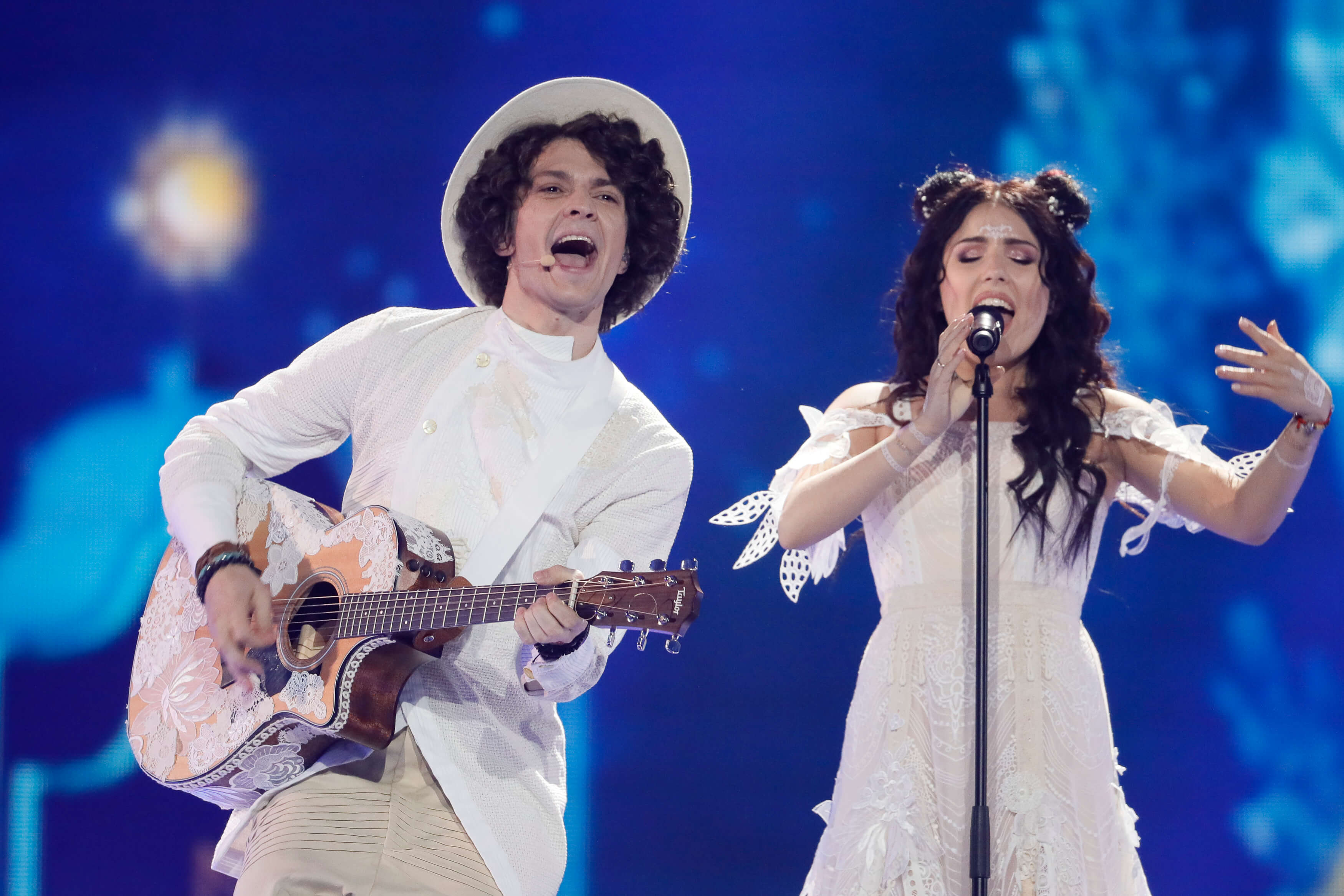
7 points: “Story Of My Life” – NAVIBAND (Belarus, 2017)
I voted for them in 2021, and to my big shock they are eligible once again despite my rules being so much more restrictive now. A travesty, but at least I get to sing this song’s praises so it isn’t all bad. This has so many things I love in Eurovision, such as a language I don’t hear much, folk, lots of happy energy. And a lot of things I love beyond Eurovision too, such as feeling intensely sincere, an absolutely incredibly catchy hook, and some very sweet lyrics. It’s good enough that I am willing to overlook the fact they made one music video with AI, but please do not do that again, Naviband.
8 points: “Intet er nytt under solen” – Åse Kleveland (Norway, 1966)
There is nothing new under the sun indeed as this song re-enters at #3 after a year of absence. It digs under your skin under your skin, and just as it lulls you into thinking one thing happens, the music changes. And changes again. Yet it all feels like a natural evolution of the songs that starts and ends with a beautiful guitar melody and some very pleasant vocals. Shocking that this isn’t in the 250 already, and hasn’t been for multiple years in a row. Norwegians, get on that voting campaign to get this and Ketil Stokkan’s Brandenburger Tor into the 250!
10 points: “Toi, la musique et moi” – Mary Christy (Monaco, 1976)
This stable rising hit is beloved by some of us at TES, yet also apparently despised by parts of the fandom? Well, sucks to be those people I guess because this song is genuinely great. Dramatic, classy, powerful, modern and timeless enough in a 70s way to fit in with the 90s lounge revival. Really, really fun, and a great song for enjoying the Côte d’Azur during a pleasant day, or while sipping on a festive cocktail during the last week of the year.
Special mentions
Before I reveal my 12 points, I would like to give a special shout-out to the songs who just missed out on making my Top 10 this time round. As is tradition, a quick shoutout to the songs I (almost) voted for in ’21, ’22, and ’23. Due to the puzzle-like nature of how my ballot comes together, I will just give a not-so-rapid rundown of the eclectic set of songs I considered heavily this year but lost out to the final song I picked, “När jag blundar”.
- Tulia – “Fire of Love (Pali się)”. Poland was robbed, robbed, robbed in this beautiful song that really provided the Eurovision blueprint for rocky folk songs at the contest, which would lead to entries such as Go_A’s “Solovey”, Alvan & Ahez’ “Fulenn”, and the return of Pasha Parfeni. Hyperbole? Perhaps, but I am willing to argue that Fire of Love played a major role in this recent rise. Also, it’s surprisingly catchy.
- Louis Neefs – “Jennifer Jennings”. Too many other Dutch-language entries I like more and therefore it missed out, but it is an absolute classic from such a strong Eurovision year. Very fun and catchy, and it has ruined my brain to the point where I always read the name of Lithuanian NF regular Erica Jennings to the tune of Jennifer Jennings.
- Luiz Ejlli – “Zjarr E Ftohtë”. From what I understand considered a controversial celebrity in Albania nowadays thanks to how he competed in (and won) Big Brother VIP Albania, but this song is still a very fun banger.
- Mandinga – “Zaleilah”. Come on, this was never going to make it in. I have a reputation to uphold. That being said, this song is disgustingly catchy and fun and more than deserves a spot in the ESC250. “Zaleilah leilah lei” is basically the 2012 pop version of what Naviband would do later with “Hey! Hey! Hay-yay-yay-a-ho!”.
- LADANIVA – “Jako”. It doesn’t feel right to include a song from a current year, and I expect this to make the ESC250 fairly handily for years to come. That being said, this is pure fun and energy and should be celebrated as such. Still not sure about how they mimed playing the instruments in the performance, I know it isn’t supposed to look perfect but the way it doesn’t just makes it not quite click for me.
- Aliona Moon – “O Mie”. I have a love/hate relationship with this song. It largely is very beautiful and Aliona performs it excellently. And I don’t necessarily mind it when a song builds tension and never releases it. But this song really needed… something extra to really make it sing to me, whereas now it really depends on my mood whether I love it or I don’t.
- Theodor Andrei – “D.G.T.”. I love sleazy rock, and 2023 offered it to me in spades courtesy of San Marino and Romania, with Romania’s song being just that little bit more impactful and engaging. It also reminded me of when I was about 18, how much simpler yet also more complex the world of love and sexuality seemed back then. That being said, and I know this is a controversial take, this song needed to be just a little bit sleazier. A more romantic take could also have worked, but I love the grittiness of this song and Theodor’s performance, and seeing it get amped up to 11 would’ve made for something truly special.
And Angus’ 12 points go to…. “Beşinci Mevsim” – Şebnem Paker (Turkey, 1996)
Şebnem Paker’s less popular Eurovision entry is my number one Eurovision song of all time for the second year in a row. I waxed lyrically last year already about the quiet melancholy in the music, the extreme emotion in the lyrics that is just bubbling under the main melody here and there, the modern staging, and the classy jazz-and-chanson style of the track. So instead I will ask you once again to sit down, listen, and hopefully vote for it next year. The 90s were an odd time for Eurovision, so let’s celebrate songs like this that are timeless yet also really of their time in a weird and beautiful way.
Listen to our collective ESC 250 playlist on Spotify
Enjoy our collective ESC 250 playlist on YouTube
Now that Angus has revealed their votes for ESC 250 this year, what do you think of their picks? Who received your 12 points this year? As always, please let us know what you think by commenting below. Be sure to follow ‘THAT Eurovision Site’ on Twitter, Facebook, Instagram, TikTok, Threads and Bluesky for all of the latest Eurovision news.
News Source: That Eurovision Site
Photo Credit: EBU / Andres Putting
 Euan T