
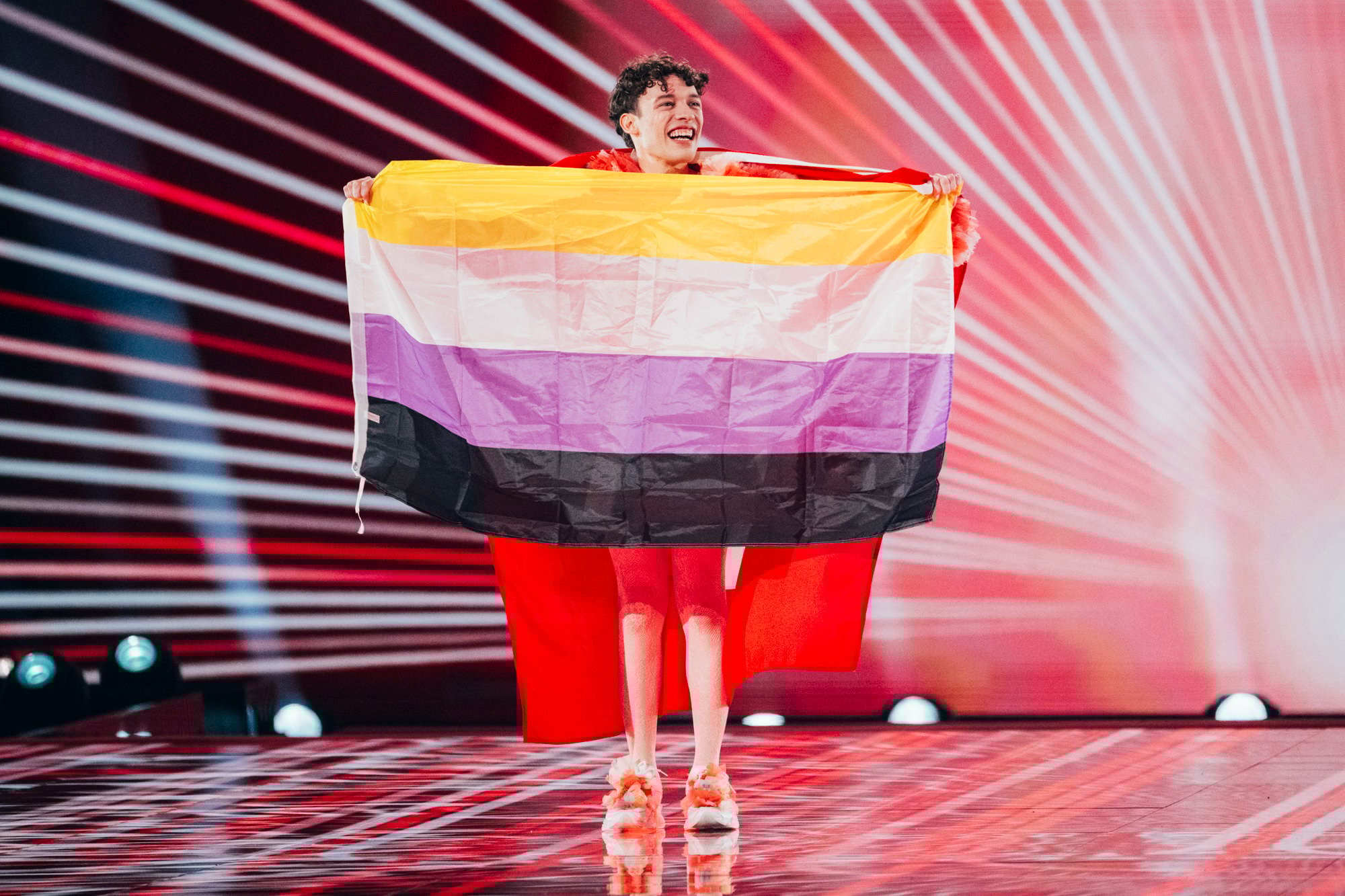
Danish broadcaster DR have revealed that the flag policy of Eurovision 2025 has been altered from previous contests, with participants now only allowed to use the flag of the country they are representing.
Rules tighten for artists, but loosen for audience
Whilst the new rules state that delegations may only appear alongside the official flags of the nations they represent at the contest, rules have loosened for spectators. Whereas previously only the flags of participating nations were allowed, in addition to the rainbow pride flag, excluding the flag of the European Union amongst others, audience members are now permitted to carry any flag unless they are in violation of Swiss law, such as flags of banned organisations.
The policy, as shared by DR, is as follows:
- All flags and banners that do not pose a risk to safety or production are permitted, except those prohibited by Swiss law. Stricter rules apply to delegations.
- Flags must not violate Swiss law. The following are considered violations of Swiss law (not exhaustive): Flags with racist and discriminatory content, including symbols that incite hatred or violence. Flags that may be considered offensive or defamatory. Flags with symbols of banned terrorist organizations.
- The following additional requirements apply to delegations: Only official flags of the country they represent in the contest are permitted in the context of any appearance on stage and/or at official venues, event(s) and performance(s) related to the Eurovision Song Contest (including the Opening Ceremony, the Eurovision Village Stage, the Main Stage and the Green Room).
- During the flag parade, only one official flag, provided by SRG SSR, is allowed.
- Security personnel and the host country broadcaster may, at their discretion, take the following measures if they believe that the requirements of this policy have not been met: Persons who do not comply with this policy may be refused entry or removed from the event without the right to a refund. Flags that do not comply with the requirements of this policy may be confiscated. For delegations, there may be additional consequences according to EBU regulations.
No room for Faroese flag
One consequence of the new flag policy is Sissal, who is representing Denmark, and is Faroese, being unable to bring a Faroese flag with her to the contest, as fellow Faroe Islander Reiley did in 2023. Speaking to DR, she said: “I am proud to be Faroese, and I know that the Faroese would be really proud to see the Faroese flag represented on stage or in the green room”. Program Manager Erik Struve Hanssen confirmed that DR have no plans to challenge the rules set out by the EBU.
Conversely, Australia’s Aboriginal & Torres Strait Islander flags are permitted due to their official status in Australian law.
All About Eurovision 2025 so far
Switzerland will be hosting the 69th edition of the competition following Nemo’s historic win at Eurovision 2024 in Malmö. A few weeks after their win, Reto Peritz, and Moritz Stadler, was announced as the Executive Producers, with the other roles revealed in July 2024.
Basel, Bern & Biel/Bienne, Geneva, and Zurich submitted bids to host next year’s competition, with Basel and Geneva being shortlisted as the final two cities. After the shortlist, it was revealed that Basel will host Eurovision 2025, at St. Jakobshalle with the shows taking place on May 13, 15 and 17.
Be sure to follow ‘That Eurovision Site’ on Facebook, Instagram, Twitter, TikTok, Threads, tumblr, and Bluesky for more information about Eurovision 2025!
News Source: DR
Photo Credit: Sarah Louise Bennett / EBU
 Giwrgos Oiko
  Samantha