
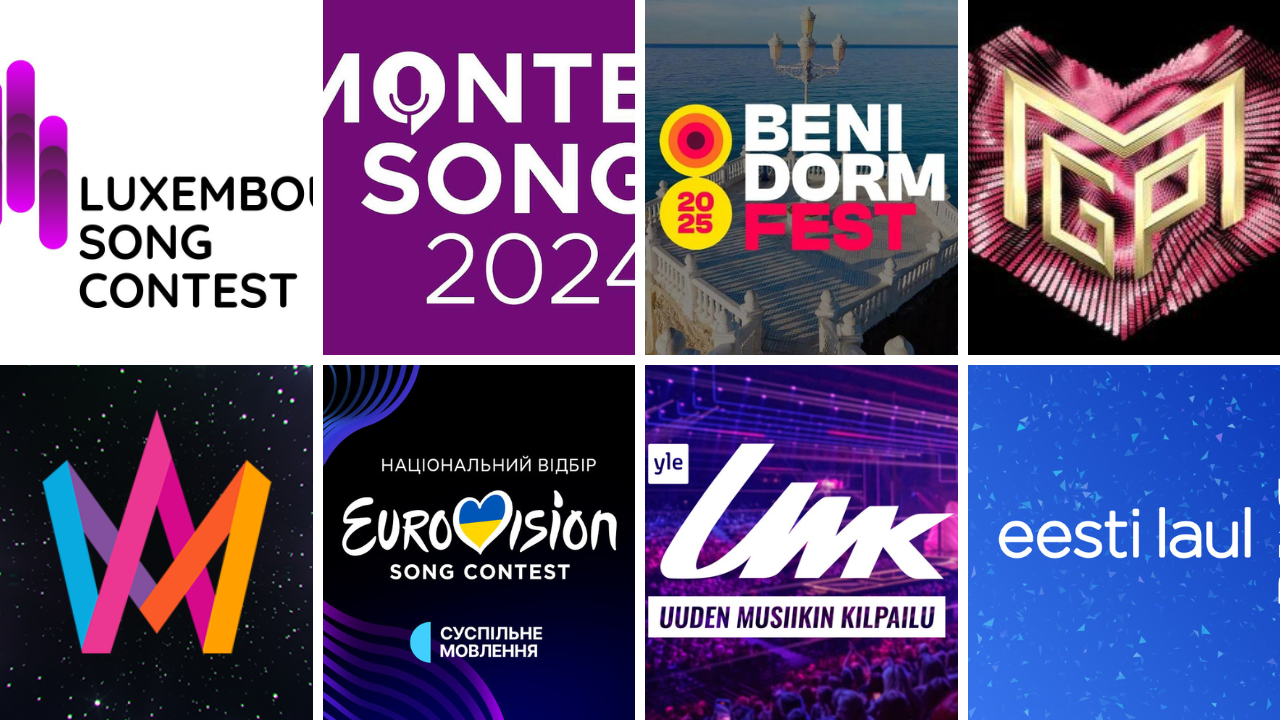
It’s November 2024, so the core Eurovision 2025 selection season is just about starting off. But if you’re new to the eurofandom, new to watching selections, or just need a refresher on how to survive the selection season, the whole experience can be a bit baffling. This guide is for you!
When do things get started?
Technically any time after 1st September, which is the start of the Eurovision year. But the bulk of selections happen between January and mid-March.
This means that countries will soon be putting on their selection shows, from the glitz and glam of the bigger 6 week long selection processes that take place in arenas (such as Sweden’s Melodifestivalen) to the smaller, more chaotic selections which feel like they take place in a village hall (San Marino, bless your cotton socks). This process is known as ‘National Selections’ or ‘National Finals’ (NF).
If you’re reading this article at time of re-publication, we’re about to have our first NF for the 2025 year from Montenegro this week. We’re currently expecting (TBC) around 28 national selections this year, more than in 2024. With new or returning selections from Greece, Poland, Armenia, Slovenia and Belgium, there’s plenty to look forward to.
So, do all countries do National Selections?
No. Some countries do an ‘Internal Selection’, which means the delegation choose their artist and song themselves. Each delegation have their own choice on what they do – it could be internal auditions, songwriting camps, or picking an already established artist. We’ve had a few countries already confirm they will use an internal process, including Czechia and United Kingdom, and from Cyprus, who have already even picked their artist.
Artists and songs from internal selections will be revealed throughout the season, alongside those already coming from NF’s. We’re still awaiting the full list of countries and their plans, so expect chaotic last minute announcements, and to suddenly find yourself tuning into a random radio station in Croatia at 7am.
Why do things need to be done by mid-March?
All artists for Eurovision (via any selection method) are presented at the Heads of Delegation meeting that happens in mid-March. The details don’t need to be available to the public, but any public selection needs to have ended by then.
This doesn’t stop them switching the song at a later date, in reality, as practically demonstrated by Malta in 2022. Whether that was a good or poor idea – well, it still didn’t qualify for the final.
Why should I watch NF’s?
I’m wildly assuming that if you enjoy Eurovision, you enjoy music. Eurovision isn’t just the 37(-ish) official Eurovision songs we get each year. There’s a whole host of new artists to discover through the NF process. Hundreds of songs and artists were involved in selections last year (and over 100 of those songs were just from San Marino).
The selections give you an insight into the music scene of each country, both good and bad. In some cases, songs from the NF’s can be just as iconic as the songs that go to Eurovision – fan favourites such as “Monument” by KEiiNO are living proof of this.
Also, the drama, memes and hilarity that come out of these selections cannot be underestimated – from singers reading their lyrics from their phones, unconventional staging choices, artists smashing up the stage and annoying yet catchy local advertising jingles, you’ll find something to entertain you during most selections.
How do I get started with watching NF’s?
The easiest way to get started is to pick a country (or several), and start watching. The real question is which countries! Once you’ve worked that out, you’re going to need a calendar. I hope you weren’t busy during the next few months because if you decide to go all in, you’re now unavailable at minimum every Saturday for 9 weeks, and for a whole week in February.
Whether you choose to follow every possible selection is up to you and your sanity levels, but if you decide to watch them all, watch out for ‘Super Saturday’.
Super Saturday sounds fun!
Well. Super Saturday is the name ‘lovingly’ given to the night where the most selections take place simultaneously. So if you’re watching multiple shows, it’s not uncommon to find yourself switching between Norwegian, Swedish, Italian or Portuguese at a rapid rate.
On Super Saturday 2024, 7 shows were running on the same night, and from the start of the first to the end of the last was what felt like one million hours. Realistically, it was about 7 hours, but it did include Malta, for which time does not pass in any sort of normal fashion.

What do I need so I can watch?
Luckily most broadcasters understand the interest in their process from overseas. In these cases you can just load up the watch link (normally the appropriate national broadcaster, or YouTube if they have it) and watch from wherever you are. If you’re very unlucky you may need to have a VPN available to be a Legitimate Citizen of Rijeka (for a 2-3 hour period).
Braving watching multiple shows? The more screens and devices you can get the better – an extra PC, laptop, your TV, a console, or even your smart fridge (is that still a thing?). Whatever extra you can get your hands on will result in much less of a headache. In addition, say your prayers to your internet provider – may your wi-fi speed be faster than the remix of Shum.
Beyond that, you just need your snacks and beverages of choice, your besties and your sanity (optional, but recommended).
What are the easier selections to start with?
By far the easiest are shows like UMK (Finland) and Melodi Grand Prix (Norway) which will take place on a single night. If you’re getting a bit braver and fancy a multi-show series, shows like Benidorm Fest (Spain) or Melodifestivalen (Sweden) or are very accessible.
At the harder end of the scale is Sanremo (Italy), which is a marathon of 5 consecutive nights and is well known for running late Every. Single. Night. Pace yourself if you’re trying this one (dedicated Sanremo fans take time work off for it) but it’s worth it for the sheer madness of it alone. (Note to experienced Eurofans: I am not debating the ‘Is Sanremo a National Final actually?’ with you right now, don’t scare the beginners off yet – let Moldova’s selection do that!)
Wait, I don’t speak the language! How can I follow along?
Some shows are kind enough to add subtitles or English commentary as part of the show, so make the most of this. You’d be surprised how much you can follow via guesswork – don’t let this be a barrier to watching. Alternatively, maybe this is your cue to start learning a new language?
But we’ve got your back at That Eurovision Site of course – join us on for liveblogging on social media where we’ll explain what’s going on, and we’ll be putting together YouTube videos before and after each show alongside plenty of coverage on our site and recap articles after for the ones you missed. There’s also the wider eurofandom on social media – why not keep an eye on the show’s hashtag, and get involved yourself?
Do we get the songs before the selection shows?
This depends on the countries. Often, the full studio tracks will be available months in advance, whereas others won’t get released until after the final – if they make it to release at all. Get ready to be disappointed when your fave never makes it to your music service of choice!
But be warned – selection shows are the artists time to shine as a performer. So be prepared to find what might have been your favourite on the recording is in fact a disaster when performed live. Or alternatively be stunned by one you ignored, who elevates it with their performance (I’m looking at you Blanca Paloma).
What are the main side effects of the National Final season?
Obviously I am fully expecting you to do your own risk assessment (we all do those, right?) but common side effects are:
- A very overburdened internet connection
- Having to put all the screens back into place that you stole from elsewhere in your house
- Crying or being bitter when your fave doesn’t win
- Back pain and a numb bum
- Eating far too many snacks
- A rapidly increasing new music playlist
- Booking a flight to a random Estonian town to see your new favourite band play live
- Having to explain what you did on the weekend to normal people
That last one is the real kicker – explaining to your colleagues that you watched 5 hours of terrible audition shows including a guy in a bright yellow bodysuit doing, umm, whatever Loco Boombox did last year in UPVSM is…well. Better tell them you just watched some paint dry or something.
And after the selection season? What comes next?
Selection season ends and we all breathe a little sigh of relief. And then we have about 2 weeks break before Pre-Party season starts! And then there’s the small matter of some sort of big ol’song contest in May? What a wild time.
How are you surviving this selection season? Do you have more tips and tricks? As always, please let us know what you think by getting involved in the comments below. Also, be sure to follow ‘That Eurovision Site’ on Facebook, Instagram, Twitter, TikTok, Threads, tumblr, and Bluesky for more information about Eurovision 2025!
Photo credit: RTL / RTCG / RTVE / NRK / SVT / UA:PBC / Yle / ERR
 Euan T
[…] If you’re new to Eurovision National Final season, why not check out our handy primer? […]
[…] If you’re new to Eurovision National Final season, why not check out our handy primer? […]